Core vs Non-core CPD for Hong Kong Physiotherapists: Scoring Rules Explained

Every three years, Hong Kong physiotherapists need 45 CPD points — and at least 23 of them must come from Core activities. Since more than half of your points have to be Core, knowing the difference between Core and Non-core isn't just academic: it decides whether you meet the requirement.
This guide draws on the Physiotherapists Board's Mandatory CPD Manual to explain what counts as Core and Non-core, how the ×1 and ×0.5 scoring works, how to tell which is which, and how to keep track without doing the maths by hand.
1. The short answer
- Core — activities directly about physiotherapy practice. Scored ×1.
- Non-core — useful, but only indirectly related. Scored ×0.5.
- Of your 45 points each cycle, at least 23 must be Core.
The catch: Non-core activities still count, but only at half value — and no amount of Non-core can stand in for the 23 Core points.
2. What the Board counts as Core vs Non-core
The Mandatory CPD Manual defines them like this:
| Core (×1) | Non-core (×0.5) | |
|---|---|---|
| Definition | Directly related to physiotherapy knowledge and skills | Not directly related, but extends your knowledge |
| Scope | Diagnosis, examination, intervention, outcome evaluation, biostatistics and epidemiology, specialty development | Health care management, Chinese herbal medicine, information technology, communication skills |
| Examples | Manual therapy workshops, sports injury courses, neuro-rehabilitation seminars, clinical research methods | Clinic operations and risk management, an introduction to Chinese herbal medicine, interprofessional team communication |
A simple test: is the activity directly about clinical physiotherapy — assessment, treatment, outcomes? If yes, it's Core. If it only supports your practice indirectly, it's Non-core.
3. Why ×1 vs ×0.5 matters
The multiplier applies to each category's base points (per hour, or per item), so the very same activity is worth half as much when it's Non-core.
🟦 Example — a 2-hour Cat I lecture:
- As Core: 2 hours × 1 = 2 points
- As Non-core: 2 hours × 0.5 = 1 point
It's also why, on the CPD Record Form, you halve Non-core points before writing them in (see our guide to filling in the CPD Record Form).
4. How to tell which one an activity is
- For accredited Cat I and II activities, the Board or organiser decides — and it's usually printed on the registration page, certificate or course details.
- For self-recorded Cat III–VI activities, you classify them yourself using the definitions above, and keep the evidence.
On CPD Database, every course and the calculator already flag Core or Non-core, so you don't have to guess.
5. Hitting the 23 Core minimum
This is the requirement people most often trip over: even a full 45 points won't pass if fewer than 23 are Core.
🟦 Example — a physiotherapist finishes the cycle with 45 points, but only 20 are Core and 25 are Non-core. The result: the total is fine, but they're 3 Core points short and still need to top up.
The fix is simple: load up on clinically focused courses first (manual therapy, sports injuries, neuro-rehabilitation, and so on) so Core is covered early, and treat Non-core as a bonus.
6. Let the tools handle the maths
Working out Core vs Non-core and halving points by hand is fiddly and easy to get wrong. CPD Database does it for you:
- The CPD calculator applies ×1 / ×0.5 automatically as you add activities.
- The course catalogue lets you browse by area, with Core status already marked.
- The member CPD tracker sorts everything for you, tracks your Core and total, and builds your CPD Record Form in one click.
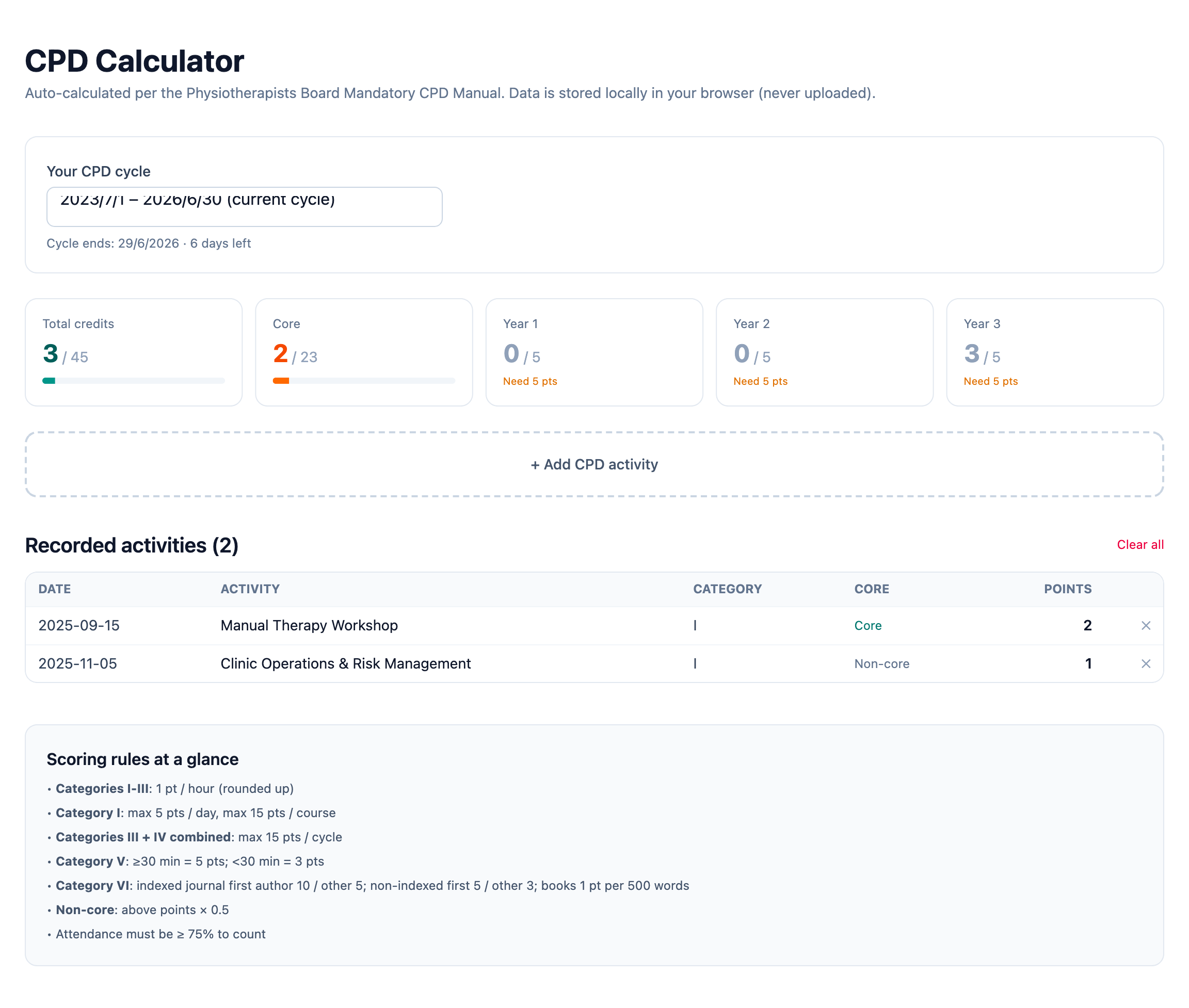
The CPD calculator below shows it in action: enter two Cat I activities, and the Core one scores ×1 while the Non-core one is automatically halved — the same 2 hours give 2 points for Core, but only 1 for Non-core.
👉 Sign up free and let CPD Database keep score — so your 23 Core points are never in doubt.
Based on the Physiotherapists Board's "Mandatory CPD Manual for Registered Physiotherapists" (May 2025). Always check the Board's latest announcements before you submit.